
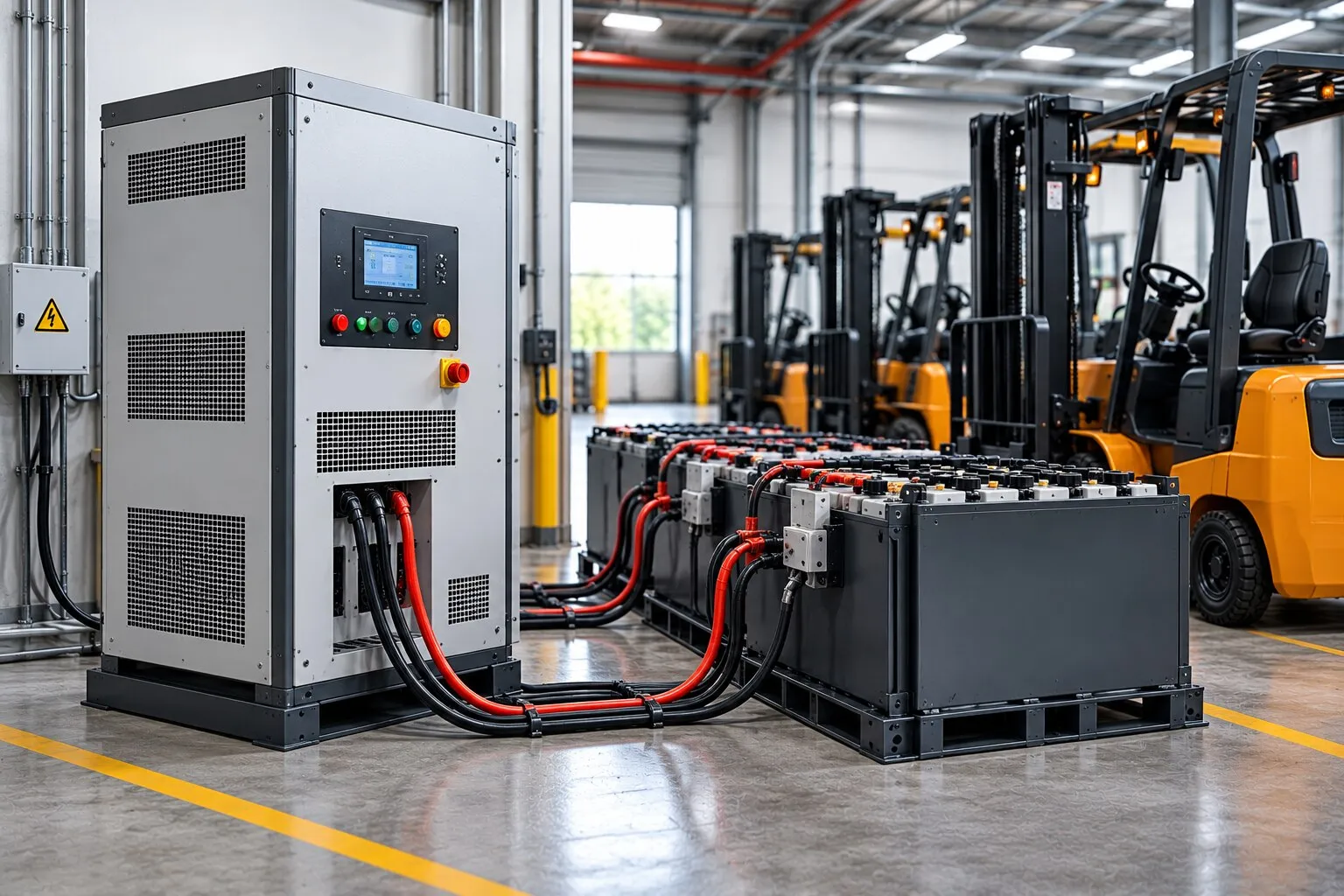
A battery that stays weak can have a charger fault, a failing alternator, excessive voltage drop, or a battery that no longer accepts charge. By the end, you will be able to distinguish an industrial FCBC system from an automotive charger, verify voltage and chemistry compatibility, size the charger, and isolate faults safely.
Key takeaways
- Match charger voltage to the battery bank before comparing current ratings.
- Use float for maintenance and boost for controlled capacity recovery.
- Measure charger output, battery voltage, and terminal voltage in sequence.
- Specify battery chemistry, bank voltage, load current, and protections before buying.
How float and boost charging work—and where automotive use begins
An FCBC charger keeps a battery connected to the DC load while managing two charging stages. Float mode holds a fully charged battery at a controlled maintenance voltage; boost mode applies a higher controlled voltage to restore capacity after discharge, then returns to float at a defined threshold.
Voltage, duration, temperature compensation, and return settings must match the battery manufacturer’s limits.
Industrial FCBC systems commonly serve 110 V or 220 V battery banks, while vehicles usually use 12 V or 24 V systems. A 24 V or 48 V FCBC cannot connect directly to a 12 V automotive battery.
Confirm the required string voltage, cell count, polarity, battery construction, and charging profile; voltage matching alone is not enough. Flooded lead-acid, AGM, VRLA, tubular, and lithium batteries require different limits and controls.
The equipment performs different jobs:
| Option | Main job | Charging role |
|---|---|---|
| Automotive alternator | Supplies the vehicle while the engine runs | Recharges through the vehicle’s electrical system |
| Bench or workshop charger | Charges a removed or isolated battery | Manual or programmed charging, usually without a continuous DC load |
| Jump starter | Delivers brief high current | Starts an engine; it does not restore battery capacity |
| Industrial FCBC charger | Supports a defined DC bus and standby battery bank | Maintains float and performs controlled boost charging |
An FCBC charger for automotive batteries is suitable only when its output and control logic explicitly support that battery and load. Engine-bay heat, vibration, and shallow cycling can still damage a battery under correct float voltage.
Cable resistance, loose lugs, isolators, and fuse holders can also reduce voltage at the battery, making a charger appear normal while undercharging it.
Match the charger to the battery bank before checking its current rating
A 24 V or 48 V FCBC charger cannot charge a 12 V automotive battery directly. Confirm the battery-bank voltage, cell count, polarity, and charging profile before comparing current ratings; matching voltage alone is insufficient if the charger control logic expects a stationary battery string.
| Battery specification | What to confirm | What goes wrong if mismatched |
|---|---|---|
| Voltage | 12 V, 24 V, 48 V, 110 V, or the specified DC bus voltage | The charger undercharges, overcharges, or damages the battery |
| Chemistry and construction | Flooded lead-acid, AGM, VRLA, tubular, or lithium; use the manufacturer’s float and boost limits | An incorrect profile causes gassing, drying, swelling, or lithium protection trips |
| Capacity | Total bank capacity in ampere-hours, including series and parallel arrangement | A bank that is too large recharges slowly; one that is too small overheats or loses autonomy |
| Load | Continuous DC load, peak or starting load, and required backup duration | The load consumes charger output, leaving insufficient current for battery recharge |
SLI automotive batteries deliver short, high-current engine starts; an industrial FCBC system is designed around a defined bank and continuous DC load. A charger labelled for automotive batteries is not automatically suitable for either application.
A search for fcbc charger automotive batteries does not provide enough specification. Give the supplier the bank voltage, chemistry, Ah capacity, continuous and peak load, desired autonomy, AC input range and frequency, ambient temperature, enclosure requirement, alarms, communications, and bypass or redundancy arrangement.
Also check voltage at the battery terminals under normal load: cable resistance, loose lugs, isolators, and fuse holders can leave the charger reading normally while the battery receives too little voltage.
Which automotive charging problems can an FCBC system actually solve?
An FCBC can correct chronic undercharging when its battery voltage, chemistry, temperature compensation, and float or boost set points match the battery. It cannot repair an alternator, battery, cable, or load.
A conventional 12 V lead-acid battery commonly charges at about 14.2–14.8 V during the main phase, then moves to a lower maintenance voltage; follow the battery maker’s specification.
| Symptom or fault | Check | What the result indicates |
|---|---|---|
| Chronic undercharging | Measure battery-terminal voltage while charging and under normal load | Low battery voltage points to settings, capacity, voltage drop, or a failed charging source |
| Overcharging | Compare terminal voltage, temperature, and set point | Excess voltage, heat, gassing, or water loss points to incorrect control or compensation |
| Sulfation or weak battery | Rested open-circuit voltage, conductance or load test, known-good comparison | Voltage rises quickly while charging current falls, indicating poor battery acceptance |
| Voltage drop or loose terminals | Measure across cables, lugs, isolators, and fuse holders under current | A normal FCBC output with low battery voltage indicates resistance in the path |
| Alternator failure or parasitic drain | Test alternator output and current draw with the vehicle off | The vehicle system, not the FCBC, is consuming or failing to supply charge |
| Polarity error | Verify positive and negative at every connection before energising | Reverse polarity prevents charging and can damage protection components |
An FCBC cannot make a 24 V or 48 V unit suitable for a 12 V battery. Confirm string voltage and polarity first; incorrect connections explain many searches for amara raja battery charger problems. Good automotive battery charging support includes checking the complete charging path, not trusting the charger display alone.
A safe multimeter sequence for separating charger faults from battery faults
A safe sequence uses DC voltage at the battery, under load, and at every charging connection; the charger display alone cannot identify a fault. Set the multimeter to DC volts, confirm polarity, and never place its current setting directly across battery terminals.
1. Switch off the charger and vehicle loads, then let the battery rest for at least four hours. Measure directly across the posts: a 12 V lead-acid battery near 12.6–12.8 V is charged, while a reading below 12.4 V indicates incomplete charge or a weak cell.
Inspect swollen cases, cracked terminals, corrosion, and loose lugs before testing further.
2. Apply a battery load tester or conductance tester using the battery manufacturer’s procedure. For a conventional 12 V load test, about half the cold-cranking-ampere rating for 15 seconds should remain above 9.6 V at 20–25 °C. A rapid voltage collapse identifies battery weakness; recharge and retest before condemning it.
3. Restore the normal charger and load. Measure at the charger output, then at the fuse or isolator, cable ends, and battery posts. The battery-side voltage must match the specified float or boost setting after allowing for temperature compensation.
Measure positive and negative voltage drop separately while current flows; excessive drop points to cable resistance, corroded lugs, or a faulty fuse holder.
Record battery temperature, charging current, and set point. A sulfated battery can reach the voltage threshold while accepting little current, creating apparent amara raja battery charger problems. This automotive battery charging support sequence separates charger, wiring, and battery faults before replacement.
What to specify when buying an FCBC charger in Gurugram
Give the supplier a complete load-and-site specification, not simply “Amara Raja FCBC chargers for automotive batteries in Gurugram.” An SLI battery in a vehicle is not automatically suitable for an industrial DC system, especially at 110 V or 220 V.
- State the required DC bus and battery-string voltage: 12 V, 24 V, 48 V, 110 V, or 220 V.
- Name the battery chemistry and construction: flooded lead-acid, AGM, VRLA, tubular, or lithium; include capacity in Ah and the number of series-connected units.
- Provide the continuous DC load, peak load, desired autonomy, and required recharge time.
- Give the site AC input voltage range, phase arrangement, frequency, and supply-fault limits.
- Specify float and boost voltage limits, temperature compensation, and any battery-management interface.
- Request alarms for charger failure, high or low DC voltage, earth fault, battery low voltage, mains failure, and overtemperature.
- State required communications, such as dry contacts, Modbus, or another monitoring protocol.
- Describe ambient temperature, humidity, dust, ventilation, altitude, enclosure or IP rating, and indoor or outdoor installation.
- Show the cable length and conductor size between charger and battery, plus isolators, fuses, and bypass or redundant-charger requirements.
Size the charger for continuous load plus recharge current, then add temperature derating and future capacity. A 10 A load needing 20 A recharge requires more than a nominal 30 A unit.
Ask GLOBAL POWER TECHNOLOGIES, or any FCBC charger supplier in Gurugram, to verify voltage at the battery terminals while that current flows; cable resistance and loose lugs can hide a charging shortfall.
Related product
Battery chargers industrial-grade Float Cum Boost Battery Chargers (FCBC) are used. View product → |
Frequently asked questions
How do float and boost charging differ in an FCBC charger?
Float charging maintains a fully charged battery at a controlled maintenance voltage. Boost charging uses a higher controlled voltage to restore capacity after discharge, then returns to float at a defined threshold.
How do you match an FCBC charger to an automotive battery bank?
Confirm the battery chemistry, nominal bank voltage, series-parallel arrangement, charging-voltage limits, connected DC load, and required charging current before selecting a charger.
Which automotive battery problems can an FCBC charger solve?
It can address undercharging, slow recovery after discharge, and loss of standby readiness when the battery and charger specifications match. It cannot repair shorted cells, severe sulphation, damaged plates, or loose connections.
How can you distinguish an FCBC charger fault from a battery fault?
Measure AC input, charger output, battery-terminal voltage, and voltage under load in sequence. A correct charger output with a battery that quickly falls under load points toward battery or connection problems.
What should you specify when buying an FCBC charger in Gurugram?
Provide battery chemistry, nominal voltage, capacity, connected load, boost and float voltage limits, current requirement, protections, installation conditions, service access, and required automotive battery charging support.
Keywords