Choosing a standby battery bank requires more than comparing ampere-hours or selecting the longest advertised design life. You will be able to compare battery formats and chemistries, calculate UPS runtime from the real load, assess parallel-string risks, and specify the tests and records required before acceptance.
Key takeaways
- Match cell voltage and chemistry to the UPS DC bus.
- Size for load, runtime, temperature, ageing and recharge limits.
- Add parallel strings only with matched batteries and balanced connections.
- Demand test records, factory data and commissioning measurements before acceptance.
What makes an SMF VRLA battery bank a complete standby DC system?
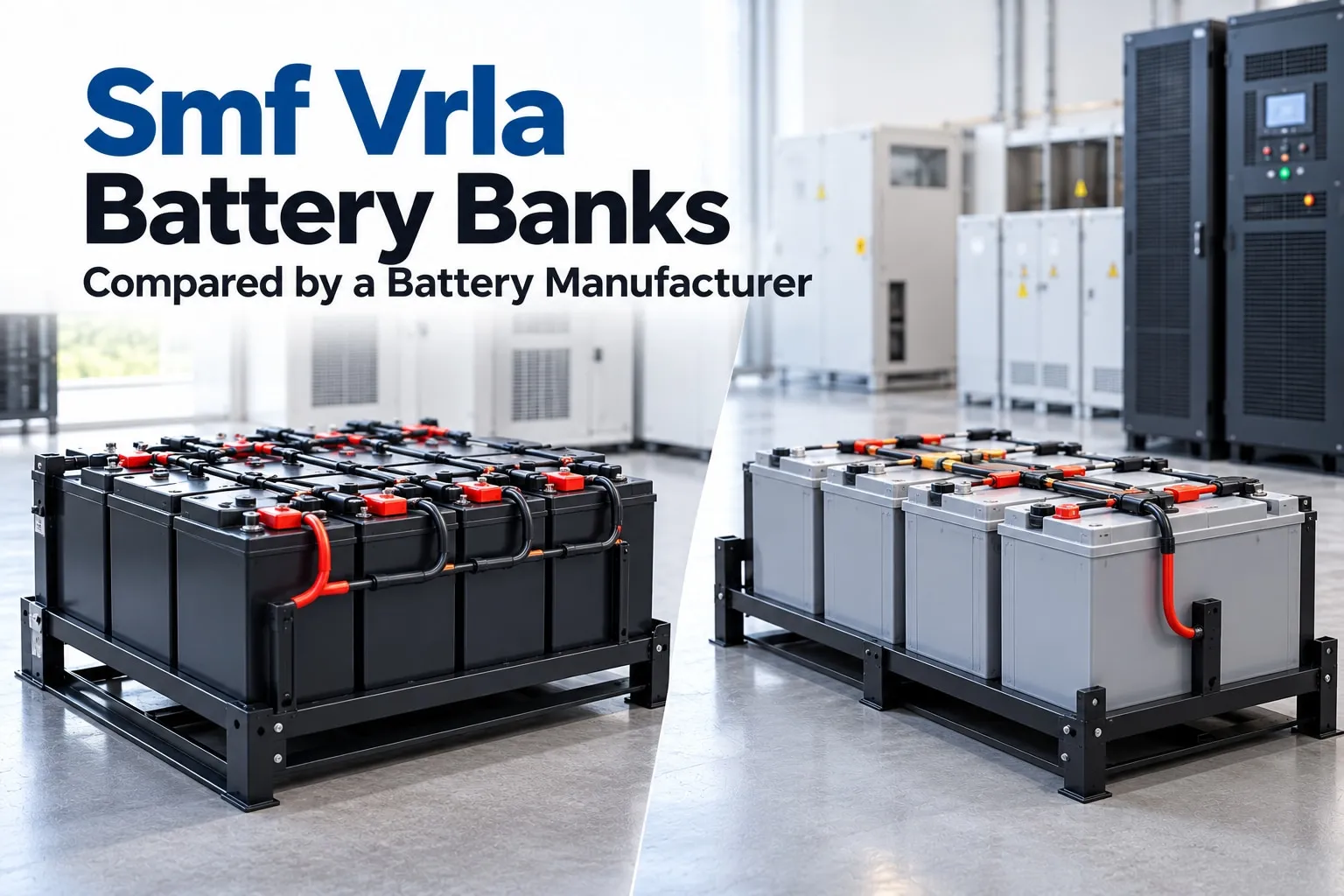
An SMF VRLA battery bank is a complete standby DC system, not a pile of batteries. Series-connected 2V cells or 6V and 12V monoblocs establish the nominal DC bus voltage; parallel strings increase ampere-hour capacity.
Racks, intercell links, terminal cables, string fuses or breakers, disconnects, chargers, and monitoring provide physical support, protection, recharge, and status visibility. A sound smf vrla battery bank comparison assesses the assembled system, not battery labels alone.
| Dimension | What to compare |
|---|---|
| Nominal voltage | Cell or monobloc count and the UPS DC-bus requirement |
| Watt-hour capacity | Usable energy at the specified discharge duration and end voltage |
| High-rate discharge | Manufacturer’s watt-per-cell or watt-per-block data for UPS loads |
| Footprint and weight | Rack space, floor loading, handling access, and replacement route |
| Expected service life | Model, temperature, float setting, cycling, and warranty conditions |
| Recharge time | Charger output and the required utility or generator recovery window |
| Temperature tolerance | Permitted ambient range and temperature-compensated charging |
| Maintenance workload | Inspection, monitoring, testing, cleaning, and replacement labour |
- Treat “maintenance free” as no routine electrolyte topping-up, not maintenance-free operation. Inspect connections, supervise charger voltage and current, and control battery temperature.
- Provide ventilation and ignition-source controls: VRLA valves can vent during overcharge, excessive temperature, or an internal fault.
- Install disconnects, insulated-tool procedures, short-circuit controls, and a documented DC arc-flash and shock assessment because fault current can be severe.
- Match charger settings to the exact model, cell count, temperature, and permitted float-voltage range; excessive voltage accelerates dry-out and thermal runaway, while low voltage leaves the bank undercharged.
How do 2V cells compare with 6V and 12V monoblocs across chemistries?
A 2V bank gives you cell-level access; a 6V or 12V monobloc gives you fewer connections and faster installation. The trade-off appears when one internal cell fails: replace the complete monobloc, whereas a 2V bank permits cell-level testing and replacement. That granularity costs more intercell links, rack labour, torque checks, and installation time.
| Format | Terminal access | Rack and handling | Failure and balancing |
|---|---|---|---|
| 2V single cells | Direct access to every positive and negative terminal | More intercell space and connection work; lift each cell individually | Isolate and test one cell; granular replacement and string balancing |
| 6V monoblocs | Fewer external terminals; internal cells remain inaccessible | Less rack wiring; moderate individual handling weight | A failed internal cell normally means replacing the complete unit |
| 12V monoblocs | Simplest cabling, especially in front-terminal layouts | Compact installation and fewer links; heavier blocks require lifting planning | Complete-unit replacement; fewer measurement points and less balancing visibility |
For industrial UPS batteries, AGM VRLA generally fits high-rate discharge because low internal resistance supports large currents. Gel VRLA can fit deeper cycling, vibration exposure, or higher ambient-temperature priorities, but confirm the model’s discharge table and recharge limits.
- Flooded lead-acid requires watering, ventilation, electrolyte spill control, and more service access.
- Lithium-ion recharges faster but requires battery-management monitoring, thermal controls, and fire-code review.
- Nickel-cadmium tolerates demanding temperatures, with different cost, disposal, and regulatory obligations.
For data center battery bank options, compare each model’s float-voltage range, end voltage, recharge limits, warranty, terminal layout, monitoring, and total replacement logistics—not nominal ampere-hours alone. A charger set outside the specified range can cause undercharge, dry-out, corrosion, or thermal runaway.
How should you size a bank for UPS runtime and recharge recovery?
A 10-minute, 15-minute, or 30-minute UPS requirement starts with real load, not the battery label. Calculate AC load as kW = UPS kVA × actual power factor, then calculate DC demand using the minimum UPS DC-bus voltage and inverter efficiency. Add any constant-current or constant-power auxiliary load.
- Specify the required autonomy at the defined load and end-of-discharge voltage.
- Select the manufacturer’s watt-per-cell or watt-per-block table for that discharge duration.
- Apply the stated design margin, aging factor, and site-temperature correction, using 25 °C as the reference condition and staying within the manufacturer’s temperature limits.
- Check that the resulting series cell or block count matches the UPS DC bus.
Do not calculate usable UPS energy by multiplying nominal volts by nominal ampere-hours. A 20-hour ampere-hour rating describes a slow test; a 10-minute UPS discharge draws a much higher rate and produces less usable capacity. Compare only matching watt-per-cell or watt-per-block data at the same duration and end voltage.
Recharge recovery is a separate acceptance requirement. Confirm that the charger can restore the defined state of charge within the available generator-start or utility-transfer window; data center battery bank options that pass runtime but fail recharge recovery are unsuitable.
For an SMF VRLA battery bank from a battery manufacturer, record float voltage against the exact model, cell count, temperature, and permitted range. A generic VRLA setting can cause undercharge, dry-out, corrosion, or thermal runaway.
What changes when you install parallel battery strings?
Two smaller parallel strings are not automatically equivalent to one larger series string. Unequal cable lengths, connector resistance, state of charge, temperature, and ageing can produce uneven current sharing or circulating current. Use symmetrical buswork, matched strings, individual string fuses or breakers, and string-level voltage, current, and temperature monitoring.
If one string fails, the remaining strings must carry the UPS load without exceeding their discharge limits, while protection coordination isolates the fault without disconnecting healthy strings.
| Layout | Access | Cable routing | Replacement time | Service isolation |
|---|---|---|---|---|
| Front-terminal | Reach terminals from the rack front | Cables stay within the cabinet face | Usually faster in dense cabinets | Easier to isolate a row before service |
| Top-terminal | Requires top access and clear working space | Cables cross above or between blocks | Slower where covers and links must be removed | Requires more clearance around live connections |
An SMF VRLA battery bank comparison should include these installation controls:
- Provide a battery disconnect, insulated tools, short-circuit controls, and documented DC arc-flash and shock assessment. Even a modest ampere-hour bank can deliver destructive fault current; maintain the specified working clearances.
- Put replacement criteria and full-string replacement rules in the procurement specification. New blocks have lower resistance than aged blocks and can carry disproportionate current, so do not mix ages without the manufacturer’s matching criteria.
- For industrial UPS batteries, require written approval for partial replacement and define when the complete string must be replaced. That decision matters more than nominal capacity alone.
What evidence should you require before accepting the bank?
Acceptance starts with evidence, not the label “maintenance free.” For an smf vrla battery bank from a battery manufacturer, match every acceptance limit to the exact battery datasheet, UPS manual, test instrument instructions, and installation or maintenance guidance, including IEEE 1187 for installation and IEEE 1188 for maintenance, testing, and replacement.
Require the commissioning team to record:
- Polarity, open-circuit voltage, cell or block voltage, internal resistance or conductance, terminal torque, intercell links, rack condition, insulation, cable identification, fuses, and breakers.
- Charger float voltage and float current against the exact model, cell count, ambient temperature, and permitted range; also record battery temperature, ventilation, and alarm status.
- Baseline readings for every cell or block, connection resistance or torque verification, and a controlled discharge or conductance result where the system design permits that test.
- Signed commissioning records, instrument identification and calibration status, test dates, deviations, corrective actions, and the approved maintenance and replacement schedule.
Treat internal-resistance readings as trend data, not a standalone health verdict, unless the manufacturer specifies that tester and method for the model. Require written warranty conditions covering float voltage, temperature, installation, and maintenance.
Battery manufacturer vrla support earns confidence when it includes duty-specific sizing, charger compatibility, installation torque requirements, acceptance criteria, and a decision on block versus full-string replacement. Evaluate GLOBAL POWER TECHNOLOGIES against those deliverables, not against “maintenance free” alone.
Related products
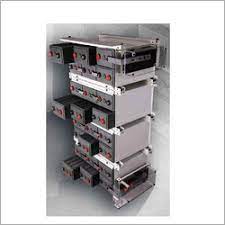 | 2V SMF VRLA Battery Bank 2V battery bank is an industrial-grade direct current (DC) power system built by connecting individual 2-volt storage cells (such as VRLA, AGM, or... View product → |
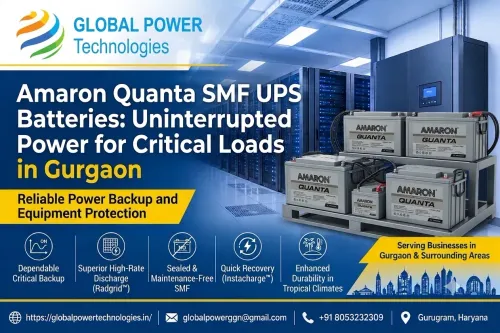
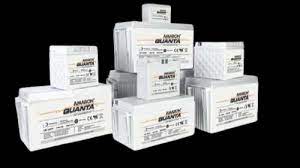 | SMF VRLA Batteries Amaron Quanta UPS batteries are sealed, maintenance-free (SMF) Valve Regulated Lead-Acid (VRLA) batteries manufactured by Amara Raja Batteries... View product → |
Frequently asked questions
What makes an SMF VRLA battery bank a complete standby DC system?
It combines series-connected cells or monoblocs, protection, interconnections, monitoring, ventilation, racks and commissioning records to support a defined DC load.
How do 2V cells compare with 6V and 12V monoblocs?
2V cells offer more individual units and service points, while 6V and 12V monoblocs simplify installation. Compare chemistry, rated life, terminal design, footprint and replacement requirements.
How should you size a bank for UPS runtime and recharge recovery?
Start with the UPS DC voltage, end-of-discharge voltage, actual kW or kVA load and required minutes. Apply temperature, ageing and design margins, then check that the charger can restore capacity within the required time.
What changes when you install parallel battery strings?
Parallel strings increase capacity but add current-sharing, fuse, isolation, cable-length and maintenance requirements. Use matched strings, equal-resistance connections and individual string protection.
What evidence should you require before accepting the bank?
Request manufacturer datasheets, factory test certificates, batch and serial records, charger settings, torque records, insulation checks, polarity checks, commissioning results and a discharge-test report.
Related products
Battery chargers industrial-grade Float Cum Boost Battery Chargers (FCBC) are used. View product → |
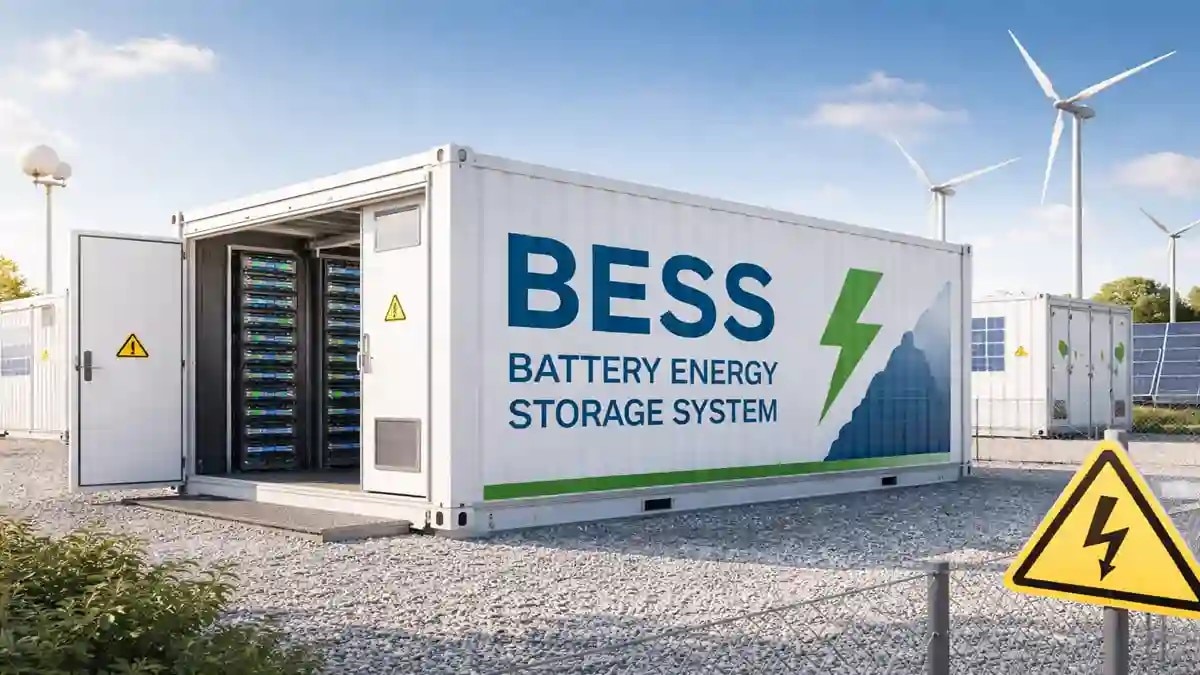 | Bess -Battery Energy storage System Bess -Battery Energy storage System Battery Energy Storage System (BESS) is a technology that captures electrical energy from the grid or renewable sources like solar and wind, stores... View product → |
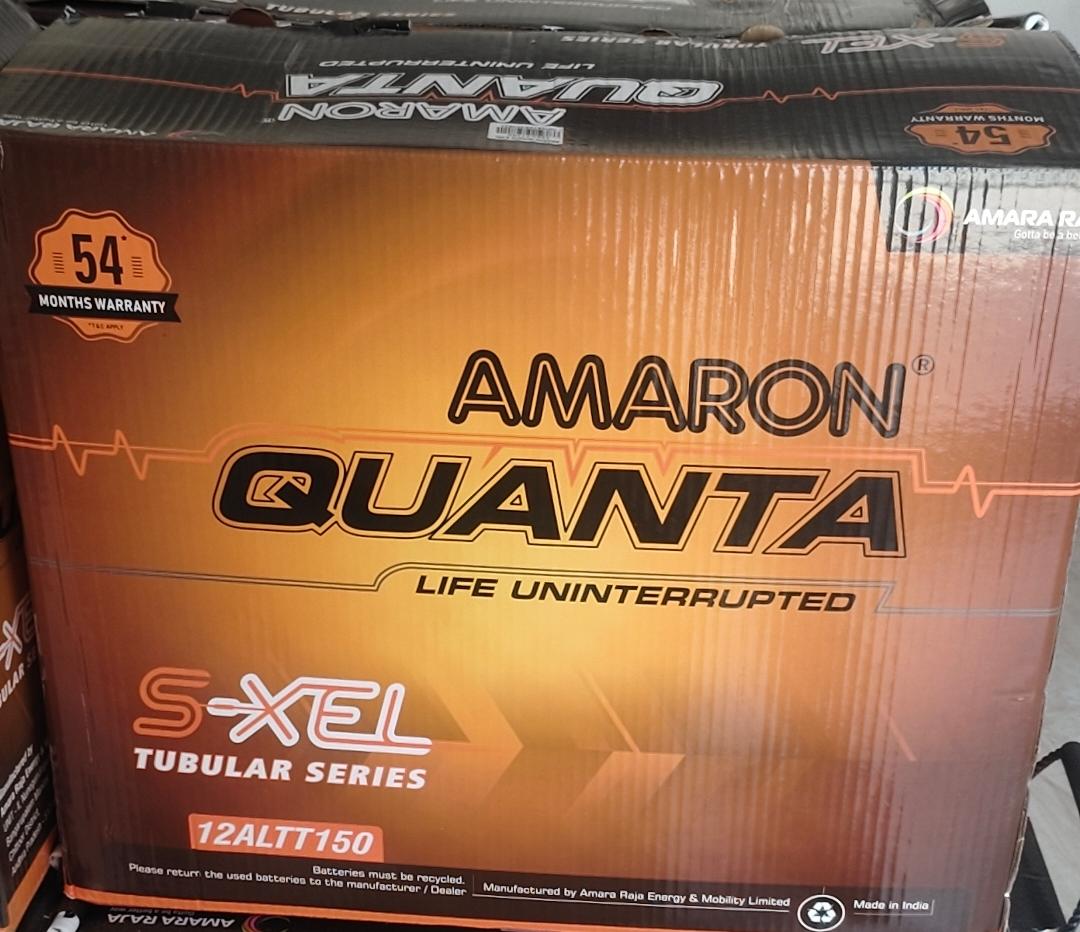 | Amaron Quanta Tubular Batteries Amaron Quanta Tubular Batteries specifically the Quanta S-XEL range manufactured by [Amara Raja], are ultra-low maintenance, deep-cycle lead-acid batteries engineered for heavy-duty... View product → |
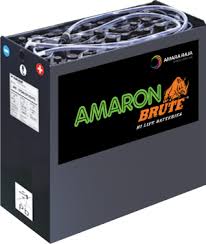 | forklift battery Amaron Brute is the latest product from the Amara Raja Energy & Mobility Limited. View product → |
Keywords