
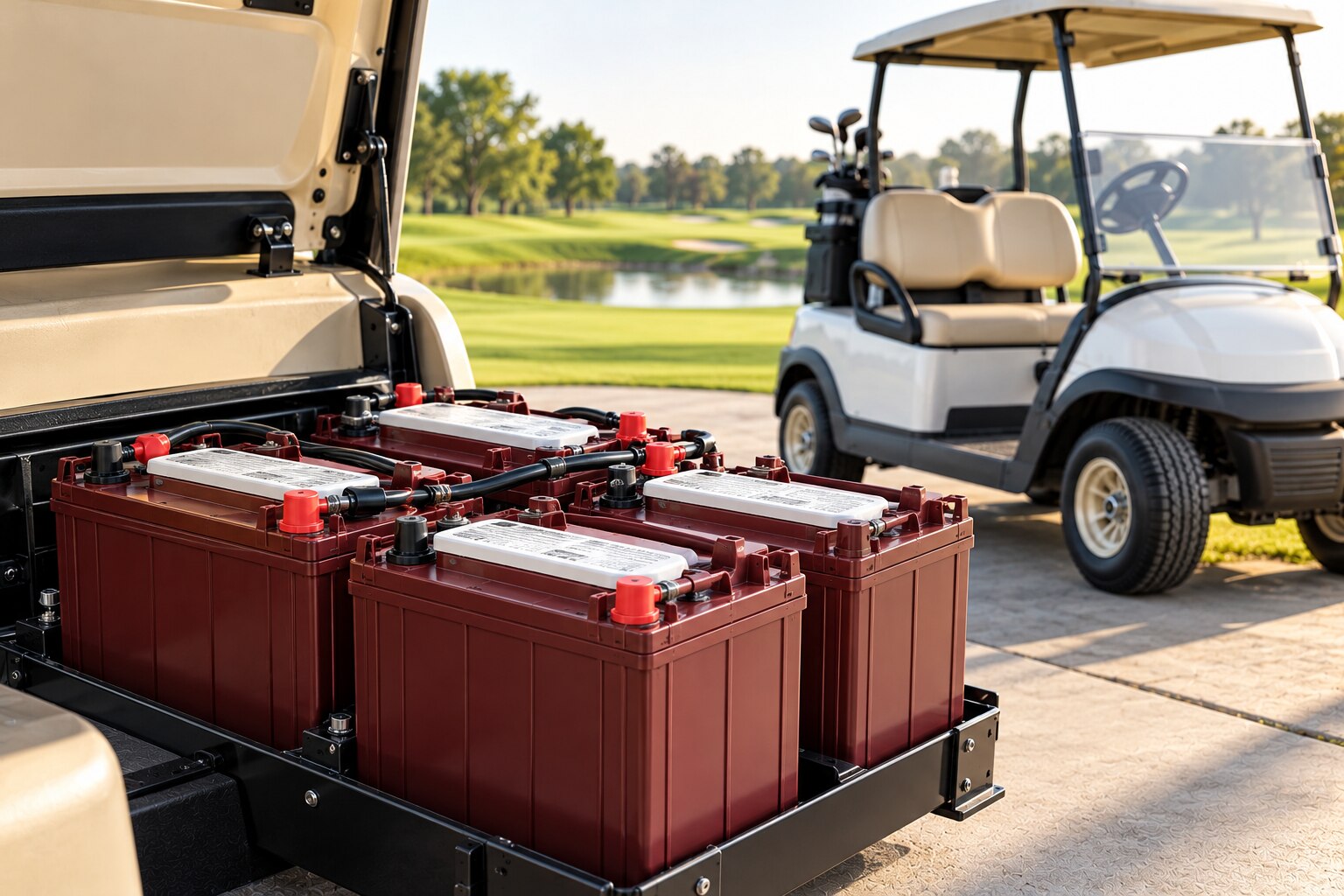
A Trojan golf-cart battery is not specified by model name alone. Voltage, amp-hour test rate, case dimensions, charging profile, production date, and warranty conditions determine whether a battery will work in your vehicle and remain supportable in fleet service. By the end, you will have a specification, fit-check, charging, and supplier-verification process for comparing quotations.
Key takeaways
- Read voltage, capacity, dimensions, terminals, and weight before comparing prices.
- Calculate total pack voltage, amp-hour capacity, energy, and available installation space.
- Match the charger profile and maintenance routine to the battery chemistry.
- Test batteries against the actual duty cycle and retain traceable supply records.
Read the Trojan specification before you compare prices
A low purchase price means little if the battery does not fit, cannot deliver the required voltage, or consumes extra labour through watering and downtime. Read the Trojan golf cart battery specifications as an integration document, not a price label. Capture the Trojan golf cart batteries battery OEM details before comparing quotations.
| Model | Electrical identity | Physical and commercial fields to freeze |
|---|---|---|
| T-875 | 8 V; 170 Ah at the 20-hour rate | Current datasheet dimensions, weight, terminal type and orientation, lifting provisions, warranty, and date code |
| T-1275 | 12 V; 150 Ah at the 20-hour rate | Current datasheet dimensions, weight, terminal type and orientation, lifting provisions, warranty, and date code |
Require these details on the quotation and purchase order:
- Exact model, nominal voltage, amp-hour test rate, end voltage, and temperature behind the capacity figure.
- Case length, width, overall height including terminals, hold-down points, cable clearance, polarity, terminal protection, and pallet configuration.
- Charger compatibility for the complete series bank; six 8 V T-875 batteries form a 48 V bank, while T-1275 units create a different series configuration.
- Manufacturing date or date code, lot traceability, storage and state-of-charge requirements, warranty start date, and transit-damage procedure.
- Delivery, GST, core return, short-shipment handling, and replacement logistics stated separately.
Compare expected cycles at your planned depth of discharge, charging-window constraints, watering labour, electricity, spare-battery cost, and return handling—not battery price alone.
Calculate pack voltage, capacity, energy, and physical fit
A quoted model is suitable only when its series voltage, capacity, energy, and envelope match the vehicle. Voltage adds in series; amp-hour capacity does not. Six T-875 batteries therefore produce 48 V and 170 Ah, while three T-1275 batteries produce 36 V and 150 Ah.
| Configuration | Calculation | Nominal result |
|---|---|---|
| Six T-875 | 6 × 8 V; 170 Ah | 48 V, 170 Ah, 8.16 kWh |
| Three T-1275 | 3 × 12 V; 150 Ah | 36 V, 150 Ah, 5.40 kWh |
| Six T-105 | 6 × 6 V; 225 Ah | 36 V, 225 Ah, 8.10 kWh |
These energy figures are nominal: voltage multiplied by amp-hours. Request the manufacturer’s discharge rate, end voltage, and test temperature before using any capacity figure. Higher current triggers Peukert losses, while cold temperatures, aging, voltage sag, and the chosen depth-of-discharge limit reduce usable energy at the vehicle terminals.
Check the complete installation, not just the case dimensions:
- Measure tray length, width, height, hold-down clearance, and ground clearance.
- Confirm terminal type, polarity, cable length, connector compatibility, and cable routing.
- Verify axle loading and total vehicle payload after installation.
- Match the charger to the complete pack voltage and chemistry; a 36 V lead-acid charger is not suitable for a 48 V bank.
- Do not replace lead-acid with lithium because the case appears similar; confirm the charger, battery-management system, fuse or contactor, low-voltage cutoff, and controller compatibility.
A battery OEM golf cart battery supply agreement should also require model, lot, date code, and pallet details so old stock is not mistaken for factory-fresh inventory.
Match the charger and operating regime to the chemistry
A charger matched to one battery can still be wrong for the vehicle: match it to the complete series bank, its nominal voltage, chemistry, and required charging profile. A 36 V lead-acid bank needs a 36 V traction-battery charger; the wrong profile creates chronic undercharge, overcharge, or damage.
| Chemistry | Charging and maintenance | Ventilation and service |
|---|---|---|
| Flooded lead-acid | Use the specified traction charger. Check electrolyte after charging; add distilled or deionized water until it covers the plates, without overfilling. | Hydrogen, acid mist, sparks, and ignition sources demand a ventilated charging area and protective equipment. Inspect levels, terminals, cables, and corrosion. |
| AES AGM | Use the AGM charge profile and avoid uncontrolled equalisation or overvoltage. No routine watering is required. | Sealed does not mean immune to charging gases or heat. Provide the ventilation required by the installation instructions and investigate swelling, leakage, or abnormal temperature. |
| OnePack lithium | Use the approved lithium charger. The battery-management system controls protection, but the vehicle still needs compatible low-voltage cutoff, contactor, and fuse arrangements. | No routine watering or hydrogen venting applies under normal operation. Service requires BMS fault records, connections, fuses, and temperature checks; follow restrictions on charging in cold conditions. |
Do not replace flooded batteries with lithium because the case appears to fit. Verify controller compatibility, charger settings, wiring, protection, and reduced battery weight before conversion.
For Trojan golf cart batteries for businesses, compare watering labour, charging windows, downtime, spare-battery needs, and service access alongside purchase price.
Test capacity against the real duty cycle, not the nameplate
A 225 Ah label does not promise 225 Ah in your vehicle. Trojan’s T-105 is rated at 225 Ah at the 20-hour rate; a higher discharge current reduces delivered capacity through the Peukert effect.
In a six-battery series string, capacity remains 225 Ah, not 1,350 Ah, and nominal energy is 36 V × 225 Ah, or about 8.1 kWh before losses.
Treat that figure as a starting point, not usable energy at the terminals. Your test plan should account for:
- The manufacturer’s discharge table, test current, cutoff voltage, and temperature; request these behind every amp-hour claim.
- The planned depth of discharge, voltage sag, temperature, battery age, and the charging window. A 50% DoD limit provides less runtime than a 100% discharge, but it can support more service cycles.
- Cycle-life data at the stated DoD, current, temperature, and end-of-life capacity threshold. A cycle figure tested at 80% DoD does not predict performance at your duty cycle.
- Capacity at the coldest and hottest operating conditions. Low temperature reduces available capacity; heat accelerates aging.
- Acceptance results for each unit: resting voltage, terminal condition, and, after a full charge, specific gravity for flooded batteries. Add a loaded or controlled discharge test; pack open-circuit voltage alone can hide a weak battery.
Record runtime, amp-hours removed, cutoff voltage, temperature, and recharge energy during a representative route. Compare that result with watering labor, charging electricity, spare-battery needs, downtime, and returns—not purchase price alone. Use the resulting evidence to validate trojan golf cart battery specifications against the real duty cycle.
Build a traceable supply and verification process
Require a purchase order that identifies the exact Trojan model, nominal voltage, Ah test rate, manufacturing date or date code, lot number, pallet configuration, terminal protection, storage state of charge, warranty start date, and GST status.
For battery OEM golf cart battery supply, add written procedures for transit damage, short shipments, core returns, and warranty claims.
Before acceptance, verify the model label against the order, count units, photograph pallet and terminal condition, inspect cases for cracks or swelling, confirm terminal polarity and dimensions, and record date codes by lot. Check storage evidence and charging requirements; open-circuit voltage alone does not prove that flooded batteries were stored correctly.
Do not accept a lithium substitute because its case appears similar.
A Gurugram quotation should expose every cost line:
| Comparison point | What to compare | Why it matters |
|---|---|---|
| Purchase price | Battery, delivery, GST, core return | A low unit price can hide logistics costs |
| Support | Local response time, commissioning, charger checks, warranty pickup | Delayed diagnosis extends vehicle downtime |
| Operating cost | Watering labour, electricity, spares, replacements | Flooded-bank maintenance changes total cost |
| Supply control | Freshness, lot records, damage process, spare availability | Old or missing stock creates replacement risk |
Ask a golf cart battery supplier in Gurugram for expected cycles at your planned depth of discharge, charging-window requirements, and a five-year replacement and spare-battery estimate. GLOBAL POWER TECHNOLOGIES can be included in the comparison only after its quotation states these same assumptions for Trojan golf cart batteries for businesses.
Related products
 | Trojan Golf Cart Batteries Trojan golf cart batteries are available in Flooded Lead-Acid, Trojan AES AGM, and Lithium-Ion (OnePack) chemistries through Indian suppliers and... View product → |
 | Golf cart Batteries Golf cart batteries are available in two main types: lead-acid (flooded or wet) and lithium-ion (LiFePO4). View product → |
Frequently asked questions
Which Trojan golf cart battery specifications matter before comparing prices?
Check nominal voltage, capacity rating, dimensions, terminal layout, weight, chemistry, operating instructions, and warranty conditions. A lower quote is not useful if the battery needs adapters, cannot meet the duty cycle, or increases maintenance labour.
How do you calculate a golf cart battery pack’s voltage and energy?
Add the voltage of batteries connected in series to find pack voltage. Batteries in parallel increase amp-hour capacity. Estimate nominal energy by multiplying pack voltage by amp-hour capacity, then compare the result with the cart’s actual load and runtime requirement.
How should you match the charger to Trojan golf cart batteries?
Match the charger’s output voltage, charging profile, connector, and current to the battery chemistry and pack configuration. Confirm the manufacturer’s charging instructions before commissioning the pack, and account for ventilation, watering, and equalisation requirements where applicable.
What should businesses verify in a battery OEM golf cart battery supply process?
Record the exact model, batch or serial information, specifications, quantity, delivery condition, warranty terms, and inspection results. Test representative batteries against the real operating cycle and retain documents that connect each shipment to its supplier and installation.
Keywords