A battery pack factory cannot size its BESS from average electricity demand or a single MWh figure. You need to verify the complete system scope, the factory’s short-duration load peaks, usable AC-side energy, battery and fire-safety evidence, local installation obligations, and the tests that convert supplier promises into acceptance criteria.
Key takeaways
- Separate energy capacity, power output, and duration in every quotation.
- Request a full equipment list, including PCS, transformer, controls, cooling, and fire protection.
- Size the BESS for measured production peaks, startup loads, and required runtime.
- Tie warranties, safety documents, commissioning tests, and handover records to the contract.
Confirm the complete BESS scope before comparing prices
A battery quotation that states only “5 MWh” is incomplete. Confirm the bess system inclusions before comparing prices: energy capacity is not the same as power output, and a rack price may exclude the equipment that makes the plant safe and usable.
Use this battery energy storage system buyer guide when requesting a revised offer:
1. List the physical equipment: cells or modules, racks or container, BMS, PCS, energy-management or site-control system, DC and AC switchgear, fuses, contactors, isolation monitoring, HVAC, fire and gas detection, suppression provisions, enclosure, metering, communications gateway, auxiliary power, transformer, cables, earthing, and emergency-stop circuits.
2. Require a single-line diagram showing the battery DC system, PCS, transformer, protection relays, metering, bypass path, point of common coupling, earthing, and every interface to the factory or utility. Ask what remains energised during maintenance bypass and a utility outage.
3. Specify documents: equipment datasheets, protection settings, control logic, load-flow and short-circuit studies, installation drawings, cable schedules, fire strategy, commissioning plan, operating manuals, maintenance schedule, training records, and test certificates.
4. Separate exclusions in the price: HT panel and transformer, civil plinth, trenching, earthing grid, crane access, fire-water infrastructure, statutory testing, utility charges, and annual HVAC or fire-system maintenance.
Check that UL 9540 evidence covers the complete BESS, not merely UL 1973 battery components. For lithium-ion equipment, request IEC 62619 evidence for the final module or rack design.
Size the system for production peaks, not average demand
A factory drawing 1,200 kW on average can still require a 2,000 kW BESS. Formation and ageing equipment, welders, compressors, HVAC, test benches, conveyors, chargers, and motor starts create short peaks that an average-demand calculation hides.
For a battery for pack manufacturing BESS system in Gurugram, use measured 1-minute or 15-minute load data from normal production, shift change, equipment startup, and the hottest operating period. Ask the supplier to model the worst simultaneous load and show:
- Power: size the PCS for the highest net deficit at the point of common coupling, including motor-start kVA, inrush current, power factor, and the required continuous and short-duration peak ratings.
- Energy: calculate usable kWh as the sustained deficit multiplied by the support duration, then add losses, the permitted state-of-charge reserve, temperature derating, and end-of-warranty capacity loss. State whether the result is AC or DC energy.
- Performance: specify peak duration, recovery time, allowable simultaneous loads, overload capability, and recharge time. Require the PCS data for operating voltage and frequency, power-factor range, harmonic current, synchronization, three-phase fault contribution, islanding, black start, and grid-following or grid-forming operation.
Check the model against a real load profile, not a nameplate total. A system that meets average demand but trips during a welder start or compressor recovery will not protect production. The quotation should also identify the promised kW and kWh at the stated temperature, SOC window, and battery end-of-life point.
Verify battery compatibility, warranty terms, and safety evidence
A battery capacity in MWh proves little without the proposed chemistry, nominal DC voltage, charge and discharge current, usable state-of-charge window, depth of discharge, cycle life, calendar life, and end-of-life capacity. Use this battery energy storage system buyer guide to demand evidence for the final module and rack design, not a generic cell datasheet.
Ask the supplier for:
- The BMS architecture, balancing method, voltage and temperature limits, isolation monitoring, contactor logic, fault alarms, data protocol, and actions during overcharge, overtemperature, communication loss, and ground fault.
- A warranty stating calendar years, energy throughput or cycle limit, guaranteed usable capacity at end of life, operating temperature, state-of-charge limits, exclusions, response time, replacement responsibility, and any augmentation requirement.
- IEC 62619 evidence for the offered industrial lithium battery, where applicable. UL 1973 evidence supports the stationary battery; UL 9540 evaluates the complete energy-storage system, so cell or module compliance alone is insufficient.
- A UL 9540A report covering the proposed cell, module, unit, and installation configuration. Check that its chemistry, enclosure, rack spacing, ventilation, and suppression assumptions match your quotation.
| Evidence | What it must match | Reject it when |
|---|---|---|
| Thermal-runaway test | Offered chemistry, enclosure, spacing, ventilation, suppression | It covers a different configuration |
| NFPA 855 installation package | Layout, separation distances, detection, suppression, emergency response, shutdown | No room or container drawings are supplied |
| Site-safety scope | Earthing, fire works, ventilation, access, statutory testing | These appear as “by others” without a priced boundary |
Ask the authority to review the NFPA 855 basis and local code edition before purchase.
Compare technologies and expose the real Gurugram project scope
Lithium-ion is not automatically the best choice. Match the technology to outage duration, load criticality, cycling, space, temperature control, and the site’s interconnection limits.
| Option | Best fit | Main constraint |
|---|---|---|
| Lithium-ion | Frequent cycling, limited footprint, fast response | HVAC, fire engineering, and end-of-life capacity evidence |
| Lead-acid | Standby service with modest cycling and lower initial cost | Large footprint, shorter life under deep cycling, ventilation and maintenance |
| UPS | No-break protection for controls, servers, and sensitive test equipment | Limited runtime unless paired with substantial battery capacity |
| Diesel | Long outages, high sustained power, or weak grid supply | Fuel storage, emissions, noise, maintenance, and transfer-switch interlocking |
| Hybrid BESS | Critical loads plus peak shaving, solar, or generator support | More controls, protection studies, commissioning, and operating rules |
For a battery pack manufacturing BESS system in Gurugram, require simulations covering formation equipment, welders, compressors, HVAC, test benches, motor starts, and simultaneous loads. Compare continuous kW, short-duration peak kW, usable kWh, recovery time, and generator operation—not average demand alone.
A bess supplier in gurugram must name the serving distribution licensee and state assumptions for sanctioned load, transformer capacity, import/export metering, protection settings, synchronisation approval, generator interlocking, and export restrictions. Confirm electrical-inspector and fire-authority approvals.
For bess for temporary project sites, add transport weight, lifting points, IP rating, temporary foundations, protected cables, earthing, lightning protection, fire clearances, security, noise, auxiliary power, relocation, and recommissioning tests. Ask GLOBAL POWER TECHNOLOGIES to separate transformer, HT panel, trenching, civil, fire, crane, statutory, and maintenance costs from the battery price.
Related product
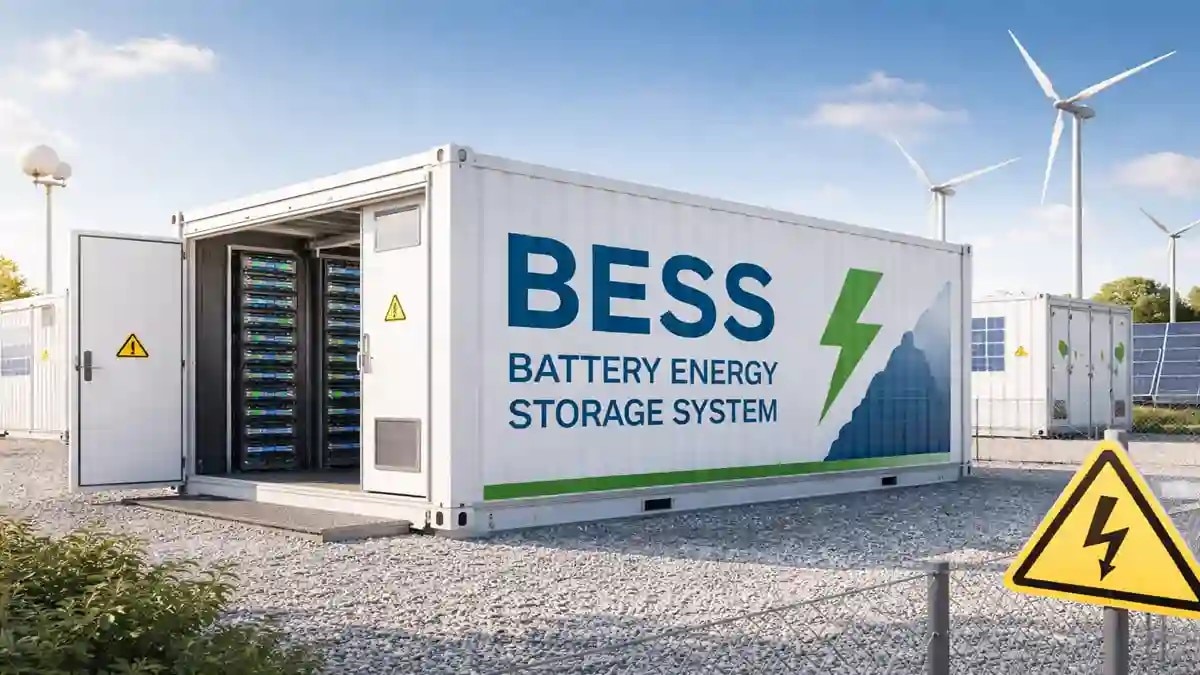 | Bess -Battery Energy storage System Bess -Battery Energy storage System Battery Energy Storage System (BESS) is a technology that captures electrical energy from the grid or renewable sources like solar and wind, stores... View product → |
Make performance, commissioning, and handover measurable
Acceptance should depend on recorded results, not a supplier’s promise that the BESS system inclusions are “standard.” Require the approved design, test procedures, limits, and punch-list rules before equipment arrives.
- Single-line diagram showing battery racks, PCS, transformer, switchgear, protection, metering, and the utility connection.
- General-arrangement drawing showing clearances, access, ventilation, fire zones, cable routes, and emergency exits.
- Control architecture and communications schedule covering BMS, PCS, EMS, HVAC, fire panel, SCADA, and remote alarms.
- Cable, earthing, protection-setting, and interlock drawings, with the sanctioned load, transformer capacity, export limit, and generator interlocking assumptions.
Compare the required evidence at each gate:
| Stage | Measure | Acceptance evidence |
|---|---|---|
| Factory acceptance | AC charge/discharge power, usable kWh within the contracted SOC window, round-trip efficiency with auxiliaries identified | Signed test sheets with calibrated instruments |
| Factory acceptance | PCS step response, overload, BMS trips, emergency stop, insulation monitoring, communications failover | Time-stamped waveforms, alarm records, and reset results |
| Site acceptance | Synchronisation, island or black-start operation, protection trips, metering, HVAC, fire detection, and suppression interfaces | Repeated tests after transport and installation |
| Handover | Operating limits, alarm responses, maintenance intervals, warranties, and training | Approved manuals, as-built drawings, passwords, spares list, and signed training record |
Keep daily charge and discharge energy, peak kW, SOC, cell temperatures, alarms, trips, downtime, and maintenance logs for trend review. A BESS supplier in Gurugram must also identify the serving distribution licensee and provide synchronization approval, electrical-inspector and fire-authority records, and the final protection settings.
Frequently asked questions
What BESS system inclusions should buyers confirm before comparing prices?
Request a line-by-line scope covering battery racks, battery management system, power conversion system, transformer, switchgear, controls, cooling, fire detection and suppression, enclosures, cabling, civil works, installation, testing, and monitoring. Confirm which items are supplied by the vendor and which remain your responsibility.
Why should a BESS be sized for production peaks instead of average demand?
Average demand hides startup surges, welding loads, motor inrush, compressor cycling, and simultaneous production events. Compare the BESS power rating in kW or MW with measured interval peaks, then check its usable energy in kWh or MWh against the required runtime and discharge limits.
What battery compatibility and warranty details should buyers verify?
Match the battery chemistry, rack voltage, operating temperature range, inverter requirements, and battery management system communications with the complete system design. Ask for warranty definitions covering usable capacity, throughput, cycle limits, calendar life, availability, response time, exclusions, and the test method used for claims.
What safety evidence should a BESS supplier provide?
Ask for battery cell and module test records, enclosure protection details, thermal-runaway detection and response procedures, fire protection design, emergency shutdown logic, site layout, electrical protection settings, and applicable test reports or certifications. Have the authority having jurisdiction review the design before installation.
What should a Gurugram BESS project scope include?
Define the site survey, electrical interconnection, transformer and switchgear work, civil foundations, access and lifting, ventilation or cooling, fire approvals, local utility coordination, installation, commissioning, operator training, spares, and maintenance. For temporary project sites, add mobilisation, demobilisation, relocation, temporary cabling, weather protection, and restoration responsibilities.
Keywords