
A fleet site may need backup for charger controls, telematics and security systems, not for the vehicles themselves. By the end, you will know how to define the load, compare a rental quotation with other power options, and verify that the equipment can be installed and accepted safely at your Gurugram site.
Key takeaways
- Use a depot UPS for chargers, networking and dispatch equipment—not vehicle traction power.
- Calculate UPS capacity from load watts and battery runtime from outage duration.
- Match input, output, phase, voltage and bypass requirements to the depot’s supply.
- Request battery age, test records, delivery scope and emergency response terms before hiring.
What Does UPS on Rent for Fleet Vehicles Actually Power?
A conventional rented UPS for a fleet normally sits at a depot, charging yard, workshop, dispatch office or temporary fleet site—not inside a vehicle. It protects AC equipment during an interruption; it is not a traction battery, vehicle inverter or road-going power system.
| Request | UPS suitability | What to use or check instead |
|---|---|---|
| Stationary site loads | Controls, networking, telematics servers, access control, CCTV, refrigeration controls, office IT, loading equipment and selected workshop tools | State the voltage, phase and exact connected load |
| EV charging | Keeps charger controls and communications alive, but does not automatically provide useful energy for charging vehicles | Compare a generator or separate battery-energy-storage system for sustained charger operation |
| Vehicle-mounted equipment | Not covered by a standard stationary rental | Check DC-bus voltage, vibration, ingress protection, electromagnetic compatibility and mounting restraint |
For ups on rent for fleet vehicles in gurugram, write the exact load in your enquiry rather than only stating the number of vehicles. Identify whether you need backup for charger electronics, a 400/415 V charging feeder, workshop tools, refrigeration, telematics or office circuits, and state the required runtime.
The practical match-up is simple: use a UPS for control, communications and IT continuity, then compare a generator or separate battery-energy-storage system when chargers must keep operating. A UPS sized for a small control panel will fail quickly under sustained charging demand.
Flag every vehicle-mounted requirement separately so the supplier does not quote stationary equipment for mobile use.
How to Size the UPS and Battery Runtime for a Fleet Site
Vehicle count does not size a UPS: a 40-vehicle depot may need less capacity than a five-vehicle site if only controls and IT remain live. A quote for UPS rental for fleet vehicles must state connected load in both kW and kVA, permitted power factor, charger count, simultaneous charging demand and starting current.
Do not treat kVA as kW when rectifiers, variable-speed drives or EV chargers are connected.
1. Give the supplier the incoming supply voltage, phase arrangement, generator capacity and generator operating limits. Identify the critical loads that must remain live, such as charger controls, networking, telematics, CCTV, access control, refrigeration controls or selected workshop equipment.
2. Separate UPS capacity from battery autonomy. Capacity is the load the unit can carry, measured in kW and kVA; autonomy is the number of minutes its batteries support that load. A UPS sized for control systems will not automatically run vehicle charging through an outage.
3. State the required ride-through period: the time to start a generator, transfer supply or complete a controlled shutdown. Require a runtime table at 25%, 50% and 100% load for the proposed battery configuration.
4. Make the calculation name the battery chemistry, battery age, ambient temperature and end-of-discharge voltage. A generic “one-hour backup” claim is incomplete because discharge rate, heat and the UPS low-voltage cutoff change runtime. Ask for the exact assumptions before comparing quotes.
Which UPS Design Fits the Depot’s Electrical System?
A 230 V single-phase office UPS does not prove suitability for a 400/415 V three-phase charger or workshop board. For temporary ups rental in gurugram, match the equipment to the depot’s incoming supply, critical load and bypass arrangement.
| Option | What it does | Best fit |
|---|---|---|
| Online double-conversion UPS | Provides VFI performance under IEC 62040-3, isolating sensitive loads from voltage and frequency variation | Controls, networking, charger electronics, poor utility supply or generator operation |
| Generator plus ATS | Supplies sustained energy; the automatic transfer switch changes sources | Long outages and charger operation |
| Voltage stabiliser | Corrects voltage variation but does not provide meaningful outage backup | Stable loads with voltage problems only |
| Battery-energy-storage system | Stores substantial energy for chargers or site loads | Extended backup and load shifting |
| Permanent UPS purchase | Provides a fixed, engineered installation | Regular, long-term depot use rather than temporary deployment |
Online conversion costs more in losses and heat than simpler designs. Ask the quotation to identify VFI, VI or VFD classification, input and output voltage, phase arrangement, neutral, earthing, internal static bypass, external maintenance bypass and bypass-feeder protection.
Record the generator’s minimum and maximum frequency and voltage, input-current distortion or harmonic behaviour, power factor, step-load response and transfer performance. Reject vague claims that omit these figures.
A fixed industrial UPS needs prepared connections, ventilation, floor space and safe battery placement. It is not automatically mobile equipment for a vehicle. For a 400/415 V load, require a three-phase demonstration or calibrated load-bank test—not evidence from a 230 V office circuit.
What to Ask a Commercial UPS Hire Provider Near Gurugram
Book directly with a commercial UPS hire provider near Gurugram that has three-phase equipment, a local commissioning team and documented fleet-site references—not a listing that only says “industrial.” Ask for a written answer to each point below.
1. Request the available continuous kW and kVA, permitted power factor, manufacturer and model, battery chemistry and age, exact autonomy at your proposed load, and the latest test report. Confirm input and output voltage, phase configuration, neutral and earthing, bypass arrangement, IP rating, noise level, footprint, cable lengths, distribution boards, cable ramps and delivery equipment.
2. Name the person responsible for the site survey, load measurement, quotation, transport, positioning, installation, commissioning, monitoring, preventive visits, breakdown response, battery replacement and removal. Require a depot-outage response time, after-hours access terms, and written responsibility for site damage or failed batteries.
3. Separate mobilisation, standby support, load-bank testing and collection from the monthly hire rate. Otherwise, a cheap quote can conceal the largest deployment costs.
GLOBAL POWER TECHNOLOGIES is worth considering only if it matches those details to the depot’s electrical design and supplies signed commissioning records; an “industrial” label proves nothing. Reject any supplier that cannot state the accepted load, runtime conditions, bypass limits and emergency contact before delivery.
Related product
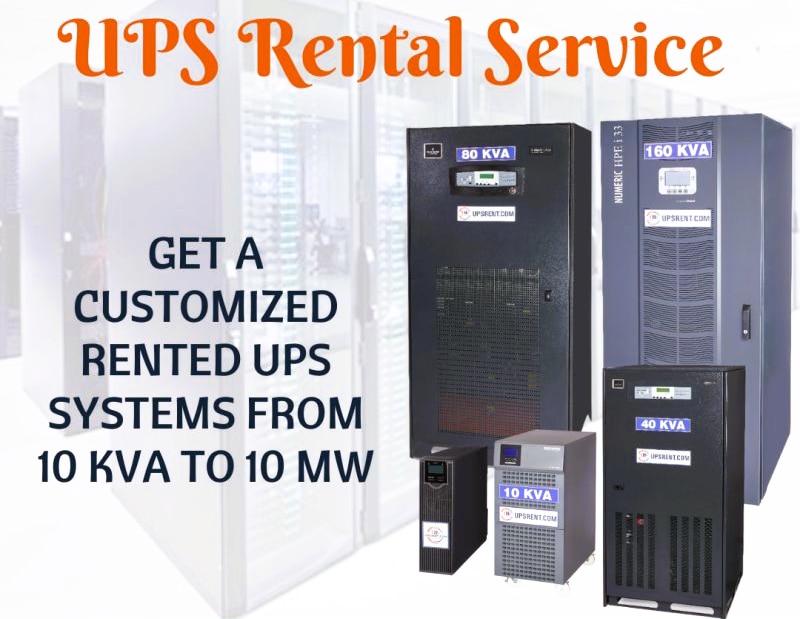 | UPS ON RENT we offer scalable, temporary power backup systems ranging from 3 kVA to over 15 MVA for businesses, data centres, hospitals, and major events. View product → |
How to Accept and Operate a Rented UPS During a Fleet Deployment
Do not energise industrial ups on rent until the quotation has become a signed handover plan. A rented installation in Gurugram remains subject to India’s Central Electricity Authority safety requirements.
1. Assign isolation, earthing, protective devices, cable sizing, installation approvals and safe energisation in writing. The rental provider owns the UPS and battery data; the site electrical contractor verifies the installation; the fleet operator provides access, operating approval and load information.
2. Commission with the actual connected load or a calibrated load bank. Record insulation resistance, protective-conductor continuity, polarity, phase sequence, bypass transfer, simulated mains failure, recharge, alarms, overload response and recovery after utility return. A no-load demonstration proves little.
3. Inspect each battery cabinet before acceptance. Confirm ventilation, temperature, fire controls, inspection access and a position away from a hot vehicle bay. For lithium systems, request the battery-management system, isolation method, safety documentation and UN 38.3 transport evidence when batteries move between sites.
4. Sign a handover pack recording the accepted load in kW and kVA, autonomy, battery temperature, end-of-discharge voltage, alarm contacts, monitoring method, maintenance dates, emergency contact and removal plan. Reject acceptance if any value is missing or differs from the quotation.
Keep the signed test results with the fleet site’s electrical records. They establish what the UPS carried, how long it ran and who must respond when an alarm, bypass event or utility failure occurs.
Frequently asked questions
What does a rented UPS power at a fleet site?
It powers AC equipment such as vehicle chargers’ controls, networking, CCTV, access systems, dispatch workstations and workshop electronics. It is not a traction battery, vehicle inverter or road-going power system.
How do you size a UPS and battery runtime for a fleet depot?
List each protected load in watts or VA, add startup and growth allowance, then select UPS capacity above the measured peak. Specify the required runtime in minutes and size the battery bank for that load and duration.
Which UPS design fits a fleet depot’s electrical system?
Check the incoming phase arrangement, voltage, frequency, earthing, output waveform, bypass path and available distribution capacity. Choose online double-conversion, line-interactive or another design according to the load’s sensitivity and the site supply.
What should you ask a commercial UPS hire provider near Gurugram?
Ask for the UPS rating, battery age and chemistry, runtime test results, maintenance history, delivery and installation scope, bypass arrangement, replacement terms, monitoring, response time and removal conditions.
How should you accept and operate a rented UPS during fleet deployment?
Record serial numbers and battery details, inspect cables and enclosures, verify alarms and transfer operation, document baseline readings, keep ventilation clear and test the planned shutdown procedure with operators.
Keywords