
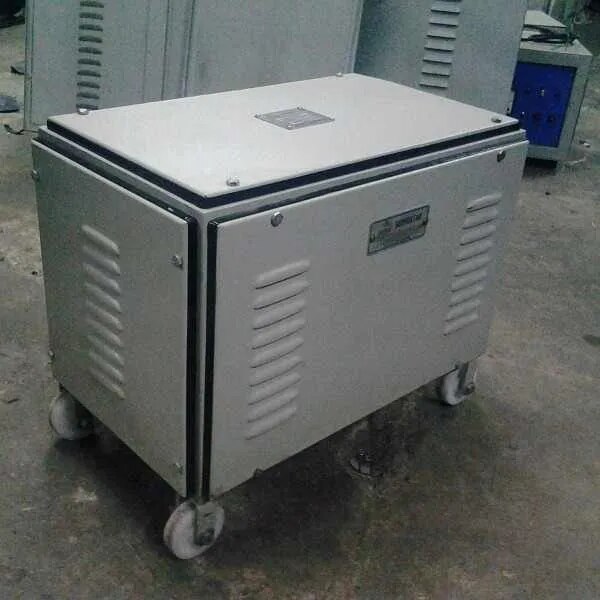
Stepdown Transformer
Description
A step-down transformer is an electrical device that decreases the alternating current (AC) voltage from a higher primary value to a lower secondary value. It accomplishes this by having fewer turns of wire on its secondary coil than on its primary coil, while simultaneously increasing the current to keep the total power constant (minus efficiency losses).
How It Works
Transformers operate on the principle of Faraday's Law of Induction.
• Primary Winding: Connected to the input voltage source ((V_{p})). It has a higher number of turns ((N_{p})).
• Secondary Winding: Connected to the output load ((V_{s})). It has a lower number of turns ((N_{s})).
The relationship is defined by the transformer turns ratio:
(frac{V_{p}}{V_{s}}=frac{N_{p}}{N_{s}}=frac{I_{s}}{I_{p}})
Because (N_s < N_p), the output voltage (V_{s}) is lower than (V_{p}), but the output current (I_{s}) is higher than (I_{p}).
Key Applications
• Power Grid Distribution: Steps down extremely high transmission line voltages (e.g., 11kV to 400V or 230V) for safe residential and commercial use.
• Consumer Electronics: Found inside power adapters and chargers for laptops, smartphones, and household appliances to reduce 230V/120V wall power down to safe levels (like 5V, 12V, or 19V).
• Industrial Machinery: Powers control circuits, relays, and low-voltage motors.
Step-Down vs. Step-Up Transformer
Feature Step-Down Transformer Step-Up Transformer
Output Voltage Lower than input voltage ((V_s < V_p)) Higher than input voltage ((V_s > V_p))
Output Current Higher than input current ((I_s > I_p)) Lower than input current ((I_s < I_p))
Turn Ratio ((N_p : N_s)) (N_p > N_s) (Primary has more turns) (N_p < N_s) (Secondary has more turns)
Primary Use Case Distributing power to homes; electronic devices Power plant generators sending electricity to the grid